FileVision

Blog

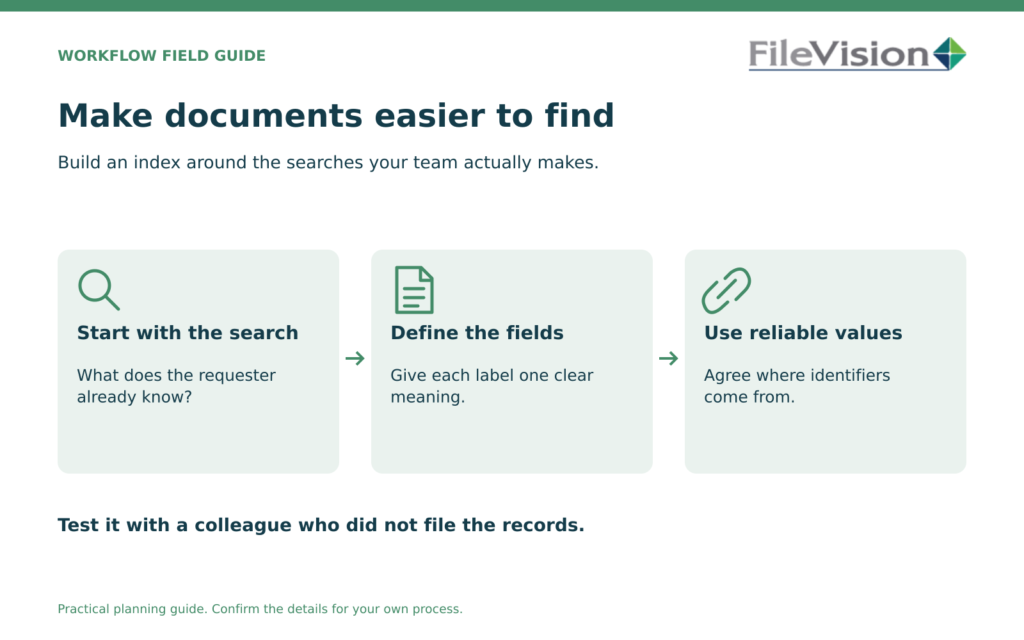
FileVision document indexing guide showing a search request, clearly defined fields and reliable identifiers, followed by a retrieval test.

Document Indexing: Choose the Fields Your Team Actually Searches

You know a document exists. You remember the customer and roughly when it arrived, but the file name means nothing. After opening several folders and asking a colleague, you finally find it under a project number you did not know. That experience is a useful starting point for document indexing. Indexing means attaching consistent descriptive

Document Indexing: Choose the Fields Your Team Actually Searches Read More »

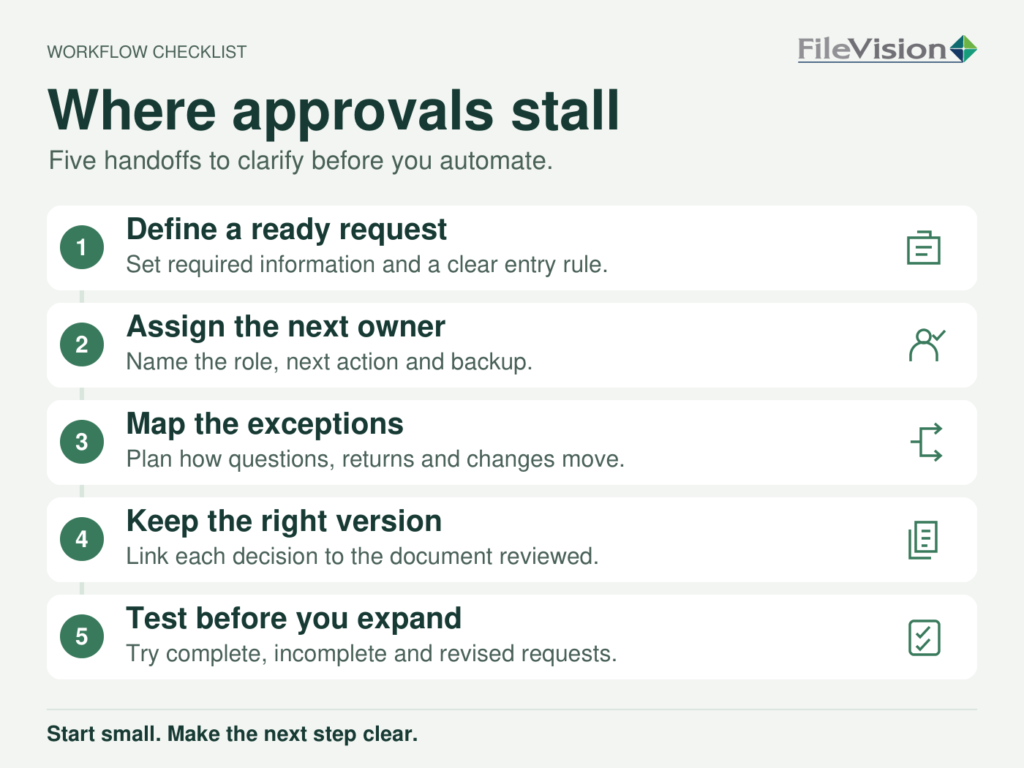
FileVision infographic: define a ready request; assign the next owner; map exceptions; keep the right document version; and test before expanding.

Where Approval Workflows Stall: A Five-Step Handoff Checklist

A request arrives by email. Its attachment goes into a shared folder. An approver asks a question in another message, and someone updates a spreadsheet to show that the request is still open. By Friday, three people have part of the story, but nobody can confidently say what happens next. That is a useful place

Where Approval Workflows Stall: A Five-Step Handoff Checklist Read More »

Building an Authentic Culture of Compliance: Moving Beyond Binders and Checklists

An authentic culture of compliance develops when following policies and procedures becomes part of how an organization operates every day. While binders, checklists, and annual training sessions can help establish expectations, they are not enough on their own. Employees need accessible guidance, clear responsibilities, and opportunities to ask questions when requirements are unclear. At ComplyVision,

Building an Authentic Culture of Compliance: Moving Beyond Binders and Checklists Read More »

Detecting Compliance Drift: How Early Risk Indicators Save Organizations from Costly Audit Penalties

Compliance rarely breaks down overnight. More often, small procedural oversights gradually develop into larger problems. An employee misses a training deadline, a department continues using an outdated policy, or a corrective action remains unresolved longer than expected. Individually, these issues may appear manageable. Across a large organization, however, they can create significant regulatory and operational

Detecting Compliance Drift: How Early Risk Indicators Save Organizations from Costly Audit Penalties Read More »

Contractor and Property Safety Compliance: Preventing Oversight Mistakes in Rapidly Changing Regulatory Environments

Managing property safety and contractor compliance involves more than scheduling inspections and collecting paperwork. Property managers, housing authorities, maintenance teams, and third-party contractors must coordinate responsibilities while keeping up with changing regulations, safety standards, and documentation requirements. When information is scattered across emails, spreadsheets, and separate departments, important details can be overlooked. At ComplyVision, we

Contractor and Property Safety Compliance: Preventing Oversight Mistakes in Rapidly Changing Regulatory Environments Read More »

From Passive Reading to Active Readiness: Modernizing Staff Training and Policy Testing Workflows

Distributing a policy does not necessarily mean employees understand it. A staff member may open a document, click an acknowledgment box, and move on without remembering the details when they actually need to apply them. For organizations managing complex regulations, multiple departments, or multiple locations, this creates a gap between policy awareness and operational readiness.

From Passive Reading to Active Readiness: Modernizing Staff Training and Policy Testing Workflows Read More »

Closing the Audit Trail Gap: How Financial Institutions Eliminate Risk in Policy Acknowledgment

In banking and merchant environments, policies can change quickly as organizations respond to regulations, industry standards, internal requirements, and emerging risks. Yet updating a policy is only one part of the compliance process. Organizations also need to know whether employees received the update, reviewed it, understood it, and completed any required training. A signed acknowledgment

Closing the Audit Trail Gap: How Financial Institutions Eliminate Risk in Policy Acknowledgment Read More »